


By: David Zhang – Senior Process Engineer, Qingdao Ouli Machine
—
In the rubber processing industry, achieving a uniform and homogenous compound is essential for producing high-performance end products. Among the various mixing technologies available, open mill rubber mixing remains one of the most widely adopted methods, especially for small to medium batch production, color mixing, and laboratory applications.
This article explores the key aspects of open mill rubber mixing, its operational advantages, and why it continues to be a preferred choice for many rubber manufacturers worldwide.
What Is Open Mill Rubber Mixing?
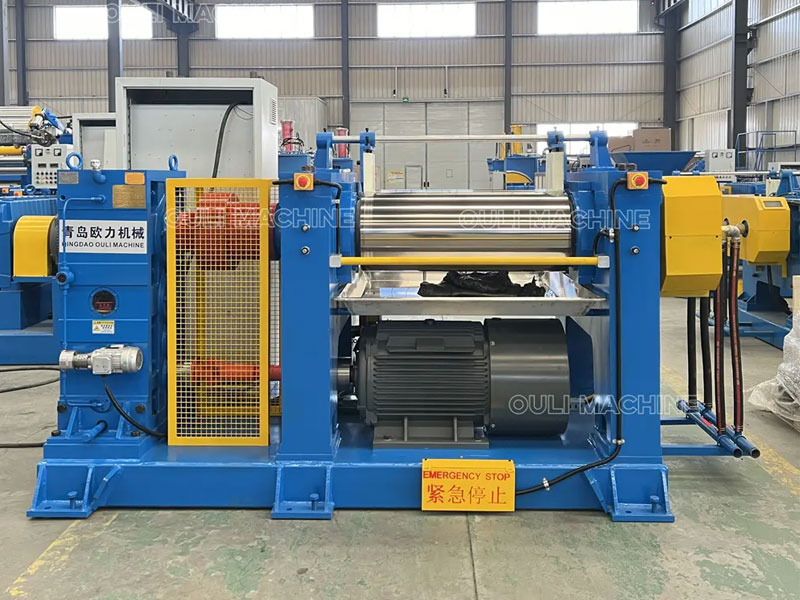
An open mill (also known as a two-roll mill) consists of two horizontally positioned, counter-rotating rolls. Rubber compound ingredients—raw rubber, fillers, plasticizers, curatives, and other additives—are placed between the rolls. The friction and shear forces generated by the roll surface break down the rubber polymer, disperse fillers, and homogenize the mixture.
The operator manually cuts, folds, and re-feeds the compound to ensure thorough blending until the desired consistency is achieved.
Why Manufacturers Choose Open Mill Rubber Mixing
1. Excellent Control Over Mixing Parameters
With an open mill, operators can visually inspect the compound at every stage. Temperature, nip gap, and roll speed ratio can be adjusted in real time, allowing for precise control of shear and dispersion. This is particularly valuable when working with heat‑sensitive materials or when developing new formulations.
2. Versatility for Different Applications
Open mills handle a wide range of rubber types—natural rubber, SBR, NBR, EPDM, silicone, and fluoroelastomers. They are equally effective for:
- Mastication (breaking down polymer chains)
- Incorporating fillers and process oils
- Adding curatives just before molding
- Producing small batches for test runs or specialty products
3. Cost‑Effective for Low‑Volume Production
Unlike internal mixers (Banbury type), open mills require a lower initial investment and simpler maintenance. They are ideal for custom mixers, R&D labs, and manufacturers who frequently change recipes or produce short runs.
4. Transparent Mixing Process
Because the compound is always visible on the rolls, operators can detect irregularities early—such as poor dispersion, scorching, or roll sticking—and take corrective action immediately. This transparency reduces waste and ensures batch‑to‑batch consistency.
Key Considerations for Efficient Open Mill Rubber Mixing
To achieve optimal results, operators should follow these guidelines:
- Proper roll temperature control: Overheating can cause premature cross‑linking (scorching), while low temperatures reduce plasticity. A cooling system (water‑circulated rolls) helps maintain stable conditions.
- Correct nip adjustment: The gap between rolls directly affects shear intensity. For most rubber compounds, a gradual reduction from wide to narrow nip yields better dispersion.
- Sequential addition of ingredients: Fillers and softeners should be added after the rubber forms a smooth band. Curatives and accelerators go in last, at lower temperatures, to prevent scorching.
- Regular safety inspections: Open mills involve manual handling near rotating parts. Install emergency stop bars, safety trip wires, and proper guarding to protect operators.
How Modern Engineering Enhances Open Mill Performance
Today’s open mills are far from the basic machines of decades ago. Advanced features include:
- PLC‑controlled roll speed and temperature for repeatable recipes
- Hydraulic nip adjustment to maintain constant gap under load
- Automatic lubrication systems to reduce downtime
- Variable friction ratios to adjust shear according to polymer type
These innovations help manufacturers achieve consistent dispersion, shorter mixing cycles, and lower energy consumption—all while preserving the flexibility that makes open mills attractive.
Common Myths vs. Reality
| Myth | Reality |
| Open mills are outdated technology. | They remain indispensable for prototyping, color mixing, and specialty compounds where internal mixers are impractical. |
| They cannot produce acceptable dispersion. | With skilled operation and well‑designed mills, dispersion meets ASTM and ISO standards for many industrial applications. |
| Open mills are unsafe. | Modern mills incorporate multiple safety devices; proper training further reduces risk. |
Conclusion
Open mill rubber mixing continues to serve as a reliable, flexible, and cost‑effective solution for rubber compound preparation. Whether for laboratory trials, small‑batch production, or specialty compounds, a well‑maintained open mill delivers consistent results that support high‑quality end products.
When selecting an open mill for your operation, consider factors such as roll size, friction ratio, cooling efficiency, and safety features. Partnering with an experienced manufacturer ensures you receive equipment tailored to your specific mixing needs.
—
David Zhang is a Senior Process Engineer with 18 years of experience in rubber mixing technology and mill design. He currently leads application engineering at Qingdao Ouli Machine, a manufacturer of open mixing mills and related rubber processing equipment.
Post time: May-09-2026


